Posts

Showing posts with the label hawk

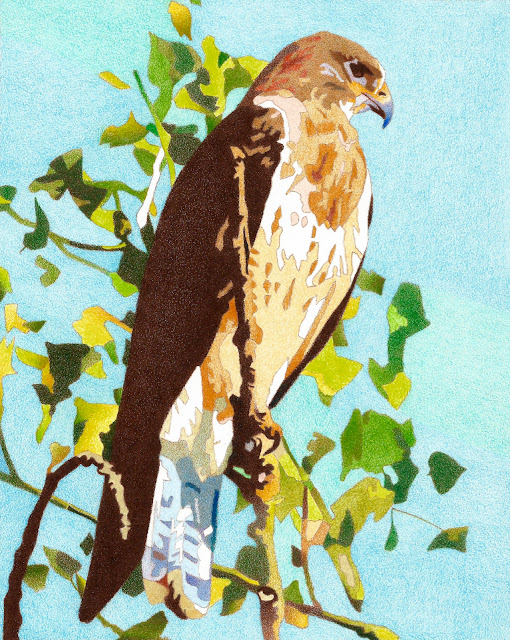
Golden Hawk - Colored Pencil Drawing
Image
"Golden Hawk" Colored Pencil Perched on a high throne decorated with a wreath of autumn leaves, a golden hawk gazes over a vast empire. The royal color scheme of blue and gold is applied in patches of similar value, resulting in a posterized portrait. Highlights and shadows are downplayed as the abstract contours exaggerate the drawing’s obvious two-dimensionality. The resplendent creature is static and solid suggesting a timeless permanence that symbolizes confidence, power and freedom. This piece does not portray a specific individual but it is more of a generic representation of a dazzling species that is so often overlooked. The monarch’s feathers are barely insinuated and the tail stripes are reduced to a simple pattern. The long, dark wing is devoid of detail, the ochre bib promotes a sand-colored chest and the yellow feet, equipped with sharp talons, melt into the mosaic of foliage. Cut out of a powder-blue sky, the noble profile of a bronze head is adorned
An Autumn Excursion - The Season of Change

Image
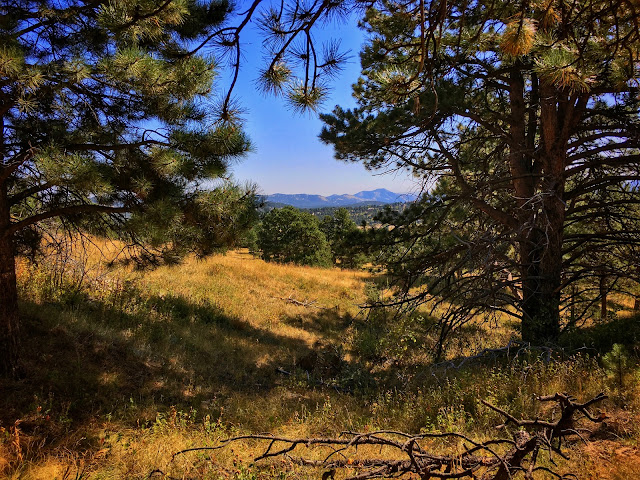
An autumn excursion September is an unpredictable month that is sometimes warm and sunny, sometimes cold and windy. It’s that slice of the year when the people, plants and wildlife are in an urgent transition as they prepare for the inevitable winter hardships. The weather this fall in the foothills has been mild so the dried grasses are a warm mixture of orange and brown. Most of the aspen trees are just beginning to change but in the deepest, darkest drainages, the groves are glowing bright yellow. During our last excursion, along the forest’s edge, we watched as a herd of elk grazed heartily while the bull bugled theatrically. A family of Abert’s squirrels gathered food furiously and horded it safely in the heights of a ponderosa pine. Most of the birds are gone but a few will stay through the cold including the hardy red-tailed hawk who will extract voles directly out of the snow. It must be the finches’ favorite time of the year as they feed on the seed-bearing thistle

Swainson's Hawk - A Graceful Buteo

Image
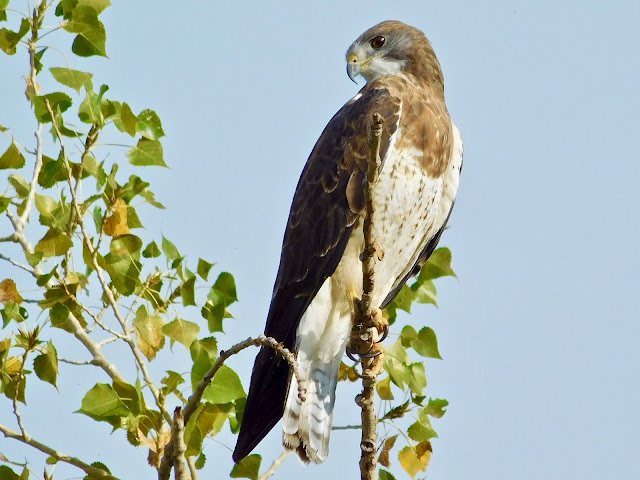
Swainson's Hawk Soaring majestically on summer thermals, the Swainson’s Hawk is a graceful buteo of the Great Plains. It gets its name from an early 19th century illustrator of natural history, Englishman William Swainson. Found mostly east of the Continental Divide, the species’ light phase is quite elegant. This narrow-winged hawk has dark flight feathers, white underwings and belly, a finely barred tail and a handsome rufous bib. Once a mated pair finds a site near the top of a solitary tree, they build a large stick nest and aggressively defend their isolated home. They feed the chicks a steady diet of rodents, rabbits and reptiles. When not in breeding season they voraciously eat a large amount of insects. They devour so many that in some rural regions of North America they are referred to as a grasshopper hawk or a locust hawk. The most remarkable behavior displayed by this amazing raptor is the astonishing, yearly migration to Argentina. In late summer they floc

American Kestrel - Heart over Height

Image
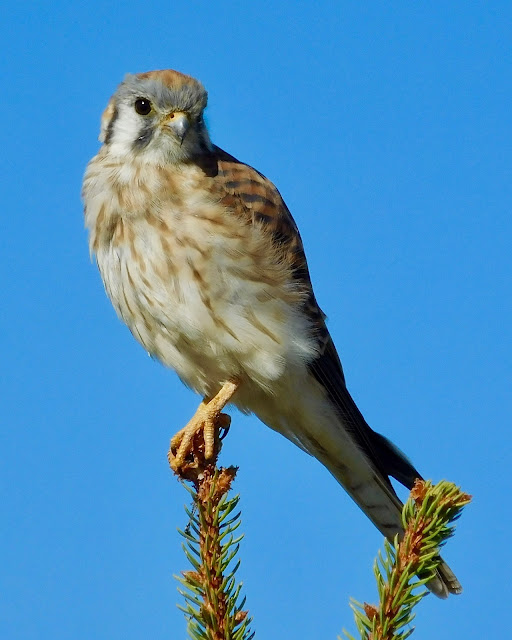
American Kestrel The American Kestrel is North America’s smallest and most widespread falcon. This pocket-sized bird of prey is extremely adaptable as she can be found anywhere in the Western Hemisphere from Alaska to the tip of Tierra del Fuego, Argentina. The most colorful of all the raptors, she is distinguished by brown wings as opposed to the male’s beautiful slate blue. Perceiving her identity is practically unmistakable while she’s perched on a small pine scanning the grassland for her favorite food; grasshoppers. She owes much of her success to a broad diet that includes almost any insect, lizards, snakes, mice and voles. She’s a ferocious predator that has the ability to take red squirrels and small birds especially sparrows while still on the wing. She’s the fearless matriarch of a tight-knit group as both parents are equally active in rearing the young. Often, the whole family will go out on a hunting foray as it’s an effective way to teach the fledglings how to s

Sharp-shinned Hawk - Colored Pencil Drawing

Image
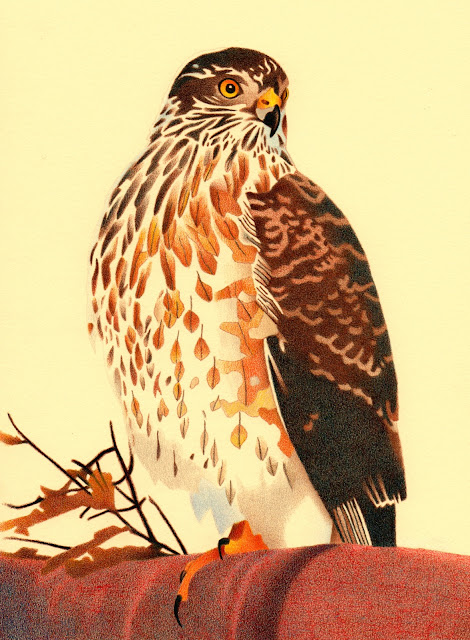
"Sharp-shinned Hawk" Colored Pencil Perched patiently on a rusty fence, a sharp-shinned hawk has appeared in a flash. It’s winter in western Nebraska and a flock of sparrows has congregated in the farmyard, feeding on chicken scratch and corn. Relying on stealth and camouflage, the sharpy prefers ambush to capture its prey. Decorated with a gold-leaf pattern, the pale chest is cloaked by dark wings that are detailed with the suggestion of broad feathers. The raptor’s noble head is a remarkable profile distinguished by streaked spear tips and bright yellow eyes. Just a juvenile, this bird of prey is a natural born hunter that’s still trying to find its place in the forest habitat. The unsuspecting sparrows are easy pickings for this woodland warrior. While living on earth can be a struggle for most of us, it’s not so for the sharp-shin. This confident creature seems to have the world by the tail.

Yellow-eyed Hawk - Colored Pencil Drawing

Image
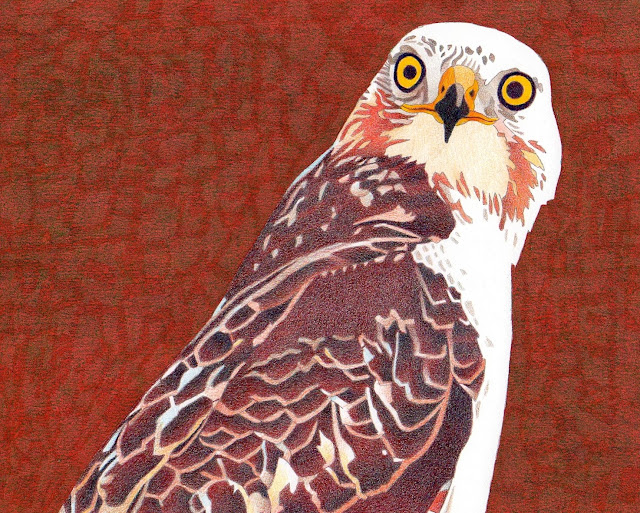
"Yellow-eyed Hawk" Colored Pencil Finding your place in the world today can be a challenge but this bird of prey is more than well-equipped to thrive in the wild. An eastern red-tailed hawk stares confidently out of a blazing, autumn background. After two years of age, the extraordinary yellow eyes of this juvenile will transform into a dark brown. Raptor vision has evolved to become the sharpest in the Animal Kingdom. The visual acuity of the hawk is legendary. Using its excellent eyesight to find and capture its prey, a red-tail can spot a rabbit from two miles away. Large eyes allow for maximum levels of light so the retinal picture is composed from a greater number of optical cells resulting in a higher resolution image. The hawk has front facing eyes that give it binocular vision which is assisted by a double fovea. With binocular vision, the fields of view of the left and right eye overlap. This binocularity allows for stereoscopic vision, which in turn provide

Red-tailed Hawk - A Versatile Raptor

Image
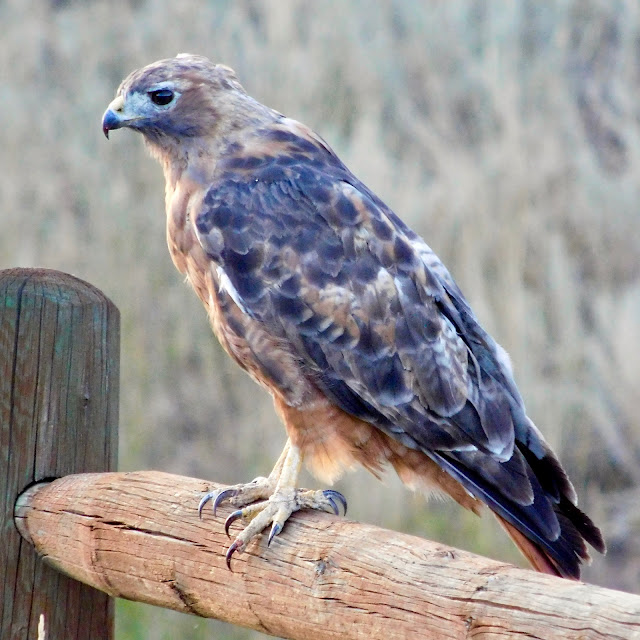
Red-tailed Hawk It's a jungle out there. Wild animals are finding it increasingly difficult to survive in an environment so drastically altered by human intervention. Despite the transformations, there is a versatile raptor that's making life in the wilderness look easy. The red-tailed hawk has benefited from forest thinning, fire suppression and construction of the interstate highway system. The red-tailed hawk has adapted to a new landscape dominated by sparse woodlands and open fields. Their numbers have increased because we've created prime hunting areas that provide ideal nest sites and elevated perches. First identified in Jamaica, the diverse red-tail is currently widespread as its range extends from Alaska and Canada south all the way to Panama. Working during the day, the broad-winged buteo soars above meadows surveying its territory for mice and possible intruders. It has a nocturnal neighbor that handles the nightshift. The red-tailed hawk frequently sha